Six packs that keep your phone and your dry layer dry when the storm hits, from a $19 roll-top to a bag you can drop in the river.
By Alex HartDay trails mostly, a few nights out a year, mountains when the time allows.
Updated Oct 2026·30 compared
We earn a commission if you buy through our Amazon links, at no extra cost to you. How this worksAmazon prices as of Nov 5, 10:16 AM ET, subject to change. Details
The Earth Pak Summit is the waterproof pack I'd get. It's a roll-top dry bag with padded straps and a hip belt, it costs about $55, and Earth Pak stands behind it for five years. Owners have carried it through a Florida hurricane and across a river in Costa Rica, and none of them describe water getting past the roll.
Pisgah is wet country. The storm comes in the afternoon, usually while you're still a long way from the car, and a rain cover only half works: the top stays dry, while water runs down your back and soaks in through the panel pressed against your shirt. One July afternoon on Black Balsam a storm caught me an hour from the car, and my phone, zipped into a hip-belt pocket I'd trusted, spent the night in a bag of rice. Since then I only care about two things when the rain starts, the phone and the dry layer I'll want the minute it stops. The mountains abroad are no better: in the Pyrenees one September, a clear morning turned to hail before lunch.
For a whole day of walking in the rain, the Downburst is the one here built on a proper hiking frame, for about $195. Gear that goes in the river, not just under the rain, belongs in the Panga, the only pack its maker calls submersible, at about $325. The cheapest way to stay dry is the MARCHWAY sack: welded seams and two straps for about $19.
500D PVC shell2.5 lb empty in 35 LOuter zip pocket is splash-proof onlyFive year warranty
+−Read the full write-upHide the full write-up
Why I picked it
Roll the top down, clip it, and the rain has nowhere to go. That's what any dry bag does. The Summit adds what most of them skip: a padded back, contoured shoulder straps, a chest strap and a hip belt, so the weight sits on your hips instead of dragging at your shoulders. One owner moved up from Earth Pak's beltless Original to the Summit for that belt alone.
Earth Pak is also straight with you about the limits. It rates the pack IPX-6, which it explains as high-pressure water from any angle, and says it shouldn't stay under water for more than five to ten seconds, because it's built to trap air and float. Knock it off a canoe and you fish it out; don't plan on sinking it. The shell is 500D PVC, the 35 L weighs 2.5 lb empty, and there are 55 L and 85 L versions at 3 lb each.
Who it is for
A soaked day hike, or a weekend where the rain gets you on the walk in and the splash gets you on the paddle out. At about $55, it's also the pack you won't wince about leaving in the bottom of a canoe.
What owners report
Owners mostly write about the weather they had it out in. A Florida owner's pack came through a hurricane dry. Others carried theirs through the rainy season in Bali, across a river in Costa Rica with camera gear inside, and around a Pacific Northwest campus. Comfort under a load comes up nearly as often, including a two-week canoe trip with the 85 L, and several people put the straps and back panel on par with packs that cost more. A small quirk: the air you leave inside puffs the bag up a little once it's rolled.
Only two buyers came away lukewarm. On his first trip, a 55 L owner had a top clip and the chest clip break, and he blames how little surface the buckles give the load. The other is the man who switched for the hip belt: he then bought the 85 L and found it far bigger than anything he actually does.
Flaws but not dealbreakers
The outside zip pocket is splash-proof and nothing more. Earth Pak even puts a card in the box telling you to keep electronics out of it.
2.5 lb before you pack anything, and no frame to carry it. For a full day on foot, the Downburst carries better.
One owner's clips broke, and a top clip is part of what holds the roll shut.
2
Spending the least
MARCHWAY Floating Dry Bag Backpack
Welded seams and two shoulder straps for about $19. Fine for the walk from the car to the water, and it folds into its own pouch between trips.
Roll it down 3 to 5 timesFloats when sealed and not overloadedTwo straps from 20 L upFolds into its own pouch
+−Read the full write-upHide the full write-up
Why I picked it
For about $19 you get a sack that keeps a downpour out and still goes on your back like a pack. The seams are welded, you roll the top down three to five times, and from 20 L up it has two shoulder straps; the 5 L and 10 L sizes only get a single sling. When the trip turns out dry, it folds into its own pouch and waits in the trunk for the next one.
Before you roll it, spread the round base open so air stays inside. MARCHWAY says that trapped air is what keeps the water out and what keeps the sack floating where you can see it. It doesn't promise more than that: not for extended submersion, in its own words.
Buy it if
You need a dry bag with straps for short carries, from the car to the boat or from the boat to camp, and you don't want to spend $55 on it.
Flaws but not dealbreakers
No published rating at all, where every other pack here gives a number or a limit. You get a description of the seal and nothing to measure it against.
No hip belt and nothing stiff in the back. Load it past a few pounds and your shoulders take all of it.
3
Carrying camp to the water
Sea to Summit Big River Dry Backpack
A serious dry bag with a padded harness and a hip belt, so you can carry camp from the boat without your shoulders paying for it.
420D TPU-coated nylon1.7 lb empty50 L quoted at three rollsWhite laminate interior
+−Read the full write-upHide the full write-up
Why I picked it
Most dry bags with straps are fine for the walk from the car to the water. The Big River is built for the carry to camp and back, trip after trip. Sea to Summit hangs a real harness on it: adjustable EVA foam straps, a sternum strap, and a hip belt in 1.5 inch webbing that comes off when you don't want it.
The bag underneath is built to match. It's 420D nylon with a TPU coating and a triple-coated base, the seams are double stitched and taped, and the roll-top is hypalon, which Sea to Summit says doesn't wick water. The side buckles are made to be replaced in the field: if one breaks at the put-in, a Phillips screwdriver swaps it in seconds, and on a bag whose closure is its only seal, that matters. It weighs 1.7 lb. When you compare volumes, remember the 50 L is measured with the top rolled three times.
Who it is for
Canoe and raft trips where the bag goes from the water to camp and back again. If your walking is counted in portages rather than miles, get this one.
What owners report
Most of what owners describe happens on the water. A paddler had it dunked again and again working past beaver dams. Others ran class I and II whitewater with it, and a family grabbed it as their evacuation bag when Helene and Milton came through back to back. The white lining gets praised more than once, because it's what lets you find a headlamp at the bottom of a deep bag.
The complaint to know about comes from a woman who sent hers back: the straps sat badly across her chest, and there's no women's version. Two other owners find the single compartment a problem. It's tall, a good part of the load rides above your shoulders, and small things sink to the bottom. Someone else wants a compression strap over the roll, and another finds the side buckles slow to clip and prone to sliding down the sides.
Flaws but not dealbreakers
One harness in one shape. If fixed straps have given you trouble before, try it on before the trip, not on it.
One deep compartment. Stuff sacks inside fix it and cost you some room.
About $170, the price of three Summits with a hip belt on each.
4
Dunkings and abuse
YETI Panga 28
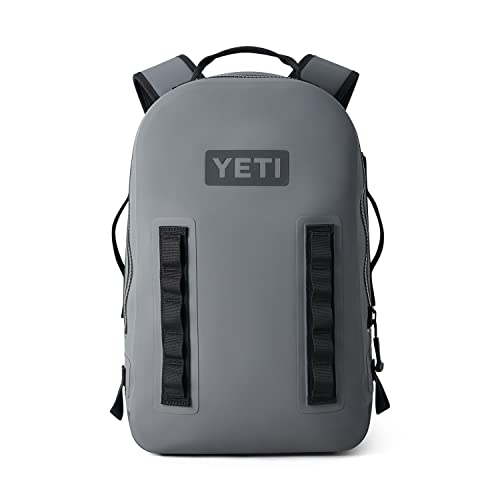
For gear that might go under, not just get rained on. It closes with a waterproof zipper, and YETI calls it submersible.
HydroLok zipperThickSkin TPU-laminated nylonChest strap and waist belt removeInterior sleeve and mesh pocket
+−Read the full write-upHide the full write-up
Why I picked it
If your pack might go under, and not just get rained on, this is the one. Every other pack here keeps water out by folding the top over on itself. The Panga closes with a zipper, the HydroLok, and that's why YETI is willing to call it airtight and submersible. The shell is high-density nylon under a thick TPU laminate made to resist punctures and abrasion, and the chest strap and waist belt both come off when they're in the way.
The zipper changes the everyday use too. There's no unbuckling, unrolling and digging: you unzip it and you're in.
Who it is for
People whose gear rides in the boat and sometimes ends up in the water: guides, anglers, photographers working on rivers. For a rainy weekend on foot, it's more bag and far more money than you need.
What owners report
What owners talk about is what the bag lived through. One had it fully under in a river and opened it to dry gear. A fishing guide who says he spends more than 200 days a year on salt water keeps his gear in one, and several owners count their time with it in years.
The complaints are few and specific. On a bag that lives in a car, the mesh pocket inside came unglued. Another buyer found it stiff and boxy from the day it arrived, closer to a carry-on without wheels than a backpack. And one man packed it with seven pounds of ice packs, found them melted every day, and realized he'd wanted a cooler.
Radio-frequency welded seams3.2 lb emptyOuter pockets are not waterproofAlso made in a 24 L women's fit
+−Read the full write-upHide the full write-up
Why I picked it
On a rainy day hike, I'd want this one on my back. It's a hiking pack first, hung on Osprey's adjustable AirSpeed suspension, the tensioned mesh that holds the pack off your back, so your shirt isn't pressed against a wet panel all afternoon. The body is welded and laminated like a dry bag, rated IPX5, and Osprey is clear that it isn't submersible.
Know where the dry part stops. The bottle pockets, the back stash pocket and the hydration sleeve sit outside the waterproof body, in quick-drying fabric on purpose. The roll-top is stiffened, there's a loop and bungee for a pole or an axe, and the whole pack weighs 3.2 lb. That's what the frame costs you.
Who it is for
Hikers who are done with rain covers. It's a day pack, in a 26 L men's fit and a 24 L women's fit, with a 36 L in Osprey's lineup, meant for a long day of weather on foot rather than for the boat. If you'd rather carry a regular daypack with a cover, here's which Osprey daypack to buy.
Flaws but not dealbreakers
3.2 lb empty, more than the 50 L Big River, and you carry every ounce of that frame all day.
The outside pockets aren't waterproof and aren't meant to be. A phone in the stash pocket gets rained on.
6
A spare that packs away
Osprey Ultralight Dry Stuff Pack
Under half a pound. Keep it folded in the pack you already own, and pull it out when the sky turns.
0.43 lb emptyCoated fabric and coated seamsStretch side pockets17.7 in tall
+−Read the full write-upHide the full write-up
Why I picked it
Keep this one folded in the bottom of the pack you already carry. When the sky turns, it becomes a 20-liter dry pack for the phone, the warm layer and the map. It's the one I'd throw in the suitcase for a trip to the mountains abroad.
At 0.43 lb it's the lightest waterproof backpack here, about a seventh of the Downburst. It uses the same IPX5 roll-top as that Downburst, but the waterproofing is a coating on the fabric and the seams rather than a weld or a tape. It stands 17.7 inches tall, the side pockets stretch, and the shoulder straps are plain mesh with a sternum strap.
Buy it if
You already own the pack you hike with and want 20 dry liters in reserve for the part of the day that's going to be wet.
Flaws but not dealbreakers
Mesh straps with nothing under them. Twenty liters of wet gear sits right on your shoulders.
About $73 for 20 L is a lot next to the MARCHWAY sack, whose seams are welded too, so what the money buys is mostly the published rating.
Who this is for
Every pack above closes without a rain cover and keeps water out of the main compartment on its own, in 20 to 50 L, for under $350. That covers a day on a wet trail, a night out, and gear that has to cross water. Once you have one, how to pack a backpack shows what goes at the bottom and what stays on top, and a water bottle for hiking that rides in the side pocket is the other thing to sort before you go.
It doesn't cover the multi-day load. Past 50 L and carried on foot for days, you want a framed backpacking pack with dry bags inside it, and that's a different guide. It doesn't cover commuting either: the roll-top city packs that show up alongside these are built around a laptop sleeve, and none of the ones I looked at publish a rating.
How to choose
How dry does it really have to stay?
"Waterproof" on a label can mean a lot of things, so look for what the maker was willing to put in writing. Earth Pak prints IPX-6 and a ten-second limit under water. Osprey prints IPX5 and the word non-submersible. MARCHWAY writes that it's not for extended submersion. YETI writes airtight and submersible. From the least to the most, that's MARCHWAY, Osprey, Earth Pak, then YETI, and each of those words is on the maker's own product page.
Rain, spray, or under water
Rain falls on the top and the shoulders, and any sealed roll-top here stops it. Spray and the odd wave hit the sides, which is where welded seams start to matter more than the fabric. Going fully under, where the bag goes in and you go in after it, is one pack on this page, and it costs about $325. Work out which of the three you actually face, because the prices here run from about $19 to about $325.
A roll-top dry bag or a waterproof daypack
It comes down to how long the pack sits on your shoulders. A dry bag with straps is fine for a hundred yards from the car to the shore. For a portage or a haul to camp, you want the load on your hips, which is where the Big River harness and the Summit belt come in. For a full day of walking you want a real roll-top daypack, with a frame and a back that breathes, and only the Downburst has that. The empty weights say the same thing: 0.43 lb gets you straps and nothing else, 3.2 lb gets you a suspension. If you already own a daypack you like, the Dry Stuff Pack folded inside it is the cheaper way to keep the phone and the dry layer dry.
What the outside pocket is really for
Nearly every pack here has a handy zip pocket on the front, and on nearly every one, that pocket sits outside the seal. Earth Pak calls its pocket splash-proof and puts a card in the box to say so again, and Osprey makes its outer pockets from quick-drying fabric on purpose. Keys, a map, a snack: fine. Anything with a battery goes inside the roll.
The competition
The other packs on my list, and why each one stayed off it.
The same 500D PVC as the Summit, a see-through panel for finding things, and about the same money. Pelican says it's not intended for submersion but gives no rating, and there's no hip belt. Those are the two things the Summit gets right at that price.
The same brand's newer, more serious pack at about $41, with a ventilated back panel, sternum and waist straps, and a rectangular base that sits closer to your spine. It's the more interesting of the two on paper, but there's still no rating, at twice the price of the sack I did pick.
About $170 for a roll-top that looks the part and sells on style as much as anything. No rating, no hip belt, and the seams aren't described as welded.
A messenger bag at heart, with a welded inner liner and a cargo net on top. The liner is the only sealed part, and the shape is drawn for a bike and a laptop.
How we picked
A closure that sealsA rating the maker publishesWelded or taped seamsTwo straps, 20 L or moreUnder $350Owner reports read
Thirty packs sold to American hikers and paddlers made the first list, from $14 dry sacks with straps up to airtight cases. For each one I took what its maker publishes: the closure, the rating or immersion limit in the maker's own words, the seams, the shell fabric, the empty weight, the capacity and the harness. A pack whose waterproofing depends on a rain cover didn't qualify.
After that came the owner reviews, critical ones first. Earth Pak and Sea to Summit publish reviews on their own product pages, and the YETI reviews come from Walmart.
There was nothing to convert for the table this time. Liters, pounds and the rating each company chose to print already line up.
Common questions
Is a waterproof backpack actually waterproof?+−
It depends on the number behind the word, and the makers do print one. IPX5 means jets of water from any direction and explicitly not immersion, which is what Osprey states for both of its packs here. IPX-6 is a step up, stronger jets, and Earth Pak pairs it with a five to ten second limit under water. Airtight and submersible, the YETI claim, is the only one meant for a bag that goes all the way in.
Can I drop a roll-top pack in the river?+−
Briefly, and only if you rolled it properly. A roll-top seals because trapped air presses against the fold, which is also why these packs float, but it's a seal held by pressure, not a lid. Earth Pak's own answer is five to ten seconds. If your gear is going to spend real time under water, you want the zipper on the Panga.
Do I still need dry bags inside?+−
For anything that can't get wet, yes, mostly because the outside pockets on most of these packs sit outside the seal. A phone in a small dry sack inside the main compartment is safe in every pack in this guide. A phone in the front pocket is only as safe as the weather is mild.
What size do I need?+−
20 to 26 L is a day, and that's what the two Osprey packs give you. 30 to 35 L takes a change of clothes and a camp meal, which is where the Summit sits. 50 L and up is a group's gear or a week on the water, and that's where a real harness stops being optional. A dry bag's stated volume assumes you rolled the top down: Sea to Summit quotes 50 L at three rolls, and you get less if you roll it more.
How do I close one properly?+−
Spread the mouth open before you start so some air stays inside, then fold the top over on itself at least three times, four if the bag isn't full, and clip the buckles. MARCHWAY asks for three to five folds, and so does Earth Pak. The air you left in there does the work, sealing the fold and keeping the pack on the surface if it goes overboard.
The verdict
Get the Earth Pak Summit
For about $55, the Summit gives you a sealed roll-top, a hip belt, a rating with its limit spelled out, and five years of warranty. Its owners have taken it through a Florida hurricane and a river crossing in Costa Rica with everything inside dry.
Pay more in two cases only. A whole day walking in the rain is worth the frame and the mesh back of the Downburst, and gear that goes under water, not just under rain, is worth the zipper on the Panga.