We earn a commission if you buy through our Amazon links, at no extra cost to you. How this works
The case for poles gets made on the way down. Going up they give your arms something to do; coming down a steep mile under a loaded pack, what owners describe again and again is knees and ankles that reach the trailhead in better shape than they used to.
We compared 24 pairs on the figures their makers publish, on the lock that holds the length, and on what owners write about both. The Black Diamond Trail is the pair to buy if you buy one pair and keep it. Spending under $30 still gets you cork and carbide in the Cascade Mountain Tech Aluminum Quick Lock, and counting grams for a fast trip points at the Black Diamond Distance Carbon Z, 120 cm.
480 g, as listedShafts 30% recycled aluminumDual FlickLockSnow baskets included
+−Read the full write-upHide the full write-up
Why we picked it
Black Diamond publishes 480 g, a 100 to 140 cm range and a 64.6 cm collapsed length, on shafts it describes as 7075 aluminum containing 30 percent pre-consumer recycled metal. Two FlickLock levers hold each pole, the grip is EVA foam with a long choke-up section below it, and carbide tips and snow baskets come in the box. That 140 cm ceiling is the highest in this guide, which matters for tall hikers and for anyone pitching a trekking-pole shelter.
At about $90 on Amazon against a $119.95 list, it sits below every carbon pair here while matching them on tips, baskets and lever type.
Who it is for
Almost everyone: day hikes, weekends, shoulder season, snowshoes. Hikers who need to save every gram, or who fly often with cabin baggage only, should look at the folding pairs further down.
What owners report
Most of what owners write on Black Diamond's page is about the descent: knees and ankles that hold up better on the way down, one of those reports from a hiker using poles for the first time. A single critical report sits among them, and it is a setup problem more than a design one. The lower section arrived stiff enough that the owner had to free the lever himself, which he knew how to do.
Flaws but not dealbreakers
A lever can arrive clamped too tight, which means freeing it with a screwdriver before the first walk.
10.4 oz per pole with tips6061 aluminumCork grip, EVA extensionFour basket sets included
+−Read the full write-upHide the full write-up
Why we picked it
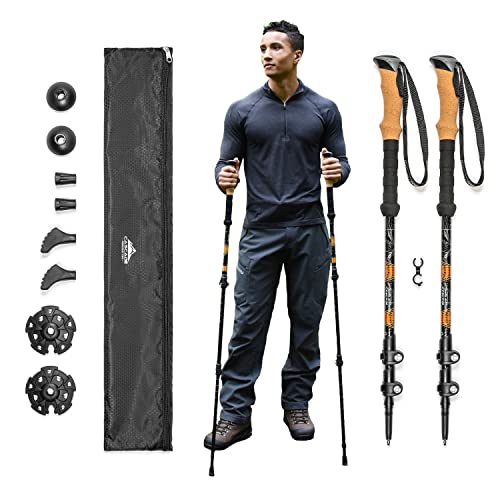
Cascade publishes 10.4 ounces per pole with the tips fitted, which is not how most makers weigh a pole: tips and baskets usually come off the scale first. The shaft is 6061 aluminum, the range runs 26 to 54 inches, and the grip is cork with an EVA extension below it. Carbide tips, snow baskets, mud baskets, rubber tips and a carry bag all come included.
Their product page also argues for the material itself, saying aluminum is less likely to snap under sideways load than carbon. Coming from a company that sells both, that is worth repeating.
Who it is for
First poles, loaner poles, poles for the family member who is not sure yet. Also the pair to pick if you hike where a tip can wedge between rocks, for the reason Cascade gives above.
What owners report
Cascade keeps its reviews behind a script we could not read, and no retailer we could open carries them either. This entry rests on the maker's published figures alone, and the gap stays visible here.
7 oz per pole on the maker's site7.6 oz per pole on its Amazon listingCork grip, EVA extensionBreaks down to 21 in
+−Read the full write-upHide the full write-up
Why we picked it
Carbon shafts, natural cork handles and padded straps for about $60, with tungsten carbide tips and interchangeable baskets included. The range is wide, 24 to 55 inches, and the poles break down to 21 inches, which Foxelli points out is shorter than most carry-on suitcases, and which none of the other adjustable pairs here manage.
Foxelli's own site says 7 oz per pole; its Amazon listing says 7.6 oz. Both figures come from the same company, so the pair sits somewhere around 14 to 15 oz and the number in the table is approximate.
Who it is for
Hikers who want cork and carbon without a three-figure price, and travelers who need poles to disappear into a suitcase.
What owners report
Most of what Foxelli publishes is positive, and two themes carry it: stiffness for the weight, and how much arrives in the box, down to two sets of baskets and a storage bag. Two owners who give their own age, both past sixty, describe less strain in the back and hips on a day with heavy elevation. One report goes the other way and lands on the part that matters most. The flip locks came unglued after three short walks in the woods, with no rock or pavement involved, which left the pole unusable.
Flaws but not dealbreakers
A lock failure appears in the owner reports, on gentle ground, early in the pole's life.
Two different weights published by the same maker, so the figure above is approximate.
4
Grams on a budget
Cascade Mountain Tech Ultralight 2-Piece Carbon
Two poles for under 12 oz, at under a third of what the lightest pair in this guide costs. The two-section build is what pays for it.
5.6 oz per pole, as listedOne joint, two sectionsEVA grip onlyCollapses to 30 in
+−Read the full write-upHide the full write-up
Why we picked it
Cascade lists 5.6 ounces per pole, which it describes as 30 percent below a standard carbon pole. That works out to 11.2 oz for two, so this pair comes in 9.6 oz under the aluminum from the same company, for about $33 more.
The saving comes from a two-section build. Where the other adjustable pairs telescope three ways, this one has a single joint, so it collapses to 30 inches, a length that rides on the outside of a pack.
Who it is for
Hikers counting grams who are not ready to spend $200. The natural comparison is the Black Diamond Distance Carbon Z, 120 cm, which is lighter still and folds much smaller, at three times the price.
280 g per pair, as listedSix fixed lengths, 105 to 130 cmKevlar in the folding cordFolds to 40 cm
+−Read the full write-upHide the full write-up
Why we picked it
Black Diamond publishes this one as Weight Per Pair, and the number for the 120 cm pair is 280 g, under 10 oz for both poles. It folds in three to 40 cm, and the fold is held by a Kevlar-cored cord in an aluminum and polyurethane mechanism.
There is no adjustment at all. You choose 105, 110, 115, 120, 125 or 130 cm when you buy, and the published weight moves with it, from 256 g to 296 g the pair. Set the length the way the FAQ below describes before you order, because the listing above is the 120 cm pair and a shorter hiker needs a different one.
Who it is for
Fast hiking, trail running, and anyone whose poles spend more of the day strapped to a pack than in hand. A fixed length also means one fewer thing to fail.
What owners report
The mechanism is where the complaints land, and they are specific. One runner reports two pairs in turn: a release button that jammed permanently on the first, a snapped plastic link on the second. An owner who likes the poles writes that one snapped in a talus field and adds that they are not as strong as heavier poles. A third broke the plastic pin after four years of moderate use. A few owners say they carry them folded in cabin baggage, which is worth reading next to the tip rule in the FAQ.
Flaws but not dealbreakers
Plastic parts inside the folding mechanism are where most reported failures start, and one owner broke a shaft as well.
No adjustment, so one pair cannot be shared between people of different heights.
486 g, as listedCarbon shaft, cork gripAluminum and steel leversTops out at 130 cm
+−Read the full write-upHide the full write-up
Why we picked it
Cork grips, carbon shafts, and FlickLock Pro levers made of aluminum and stainless steel rather than the nylon used lower down the range. Black Diamond publishes 486 g, a 100 to 130 cm range and a 61 cm collapsed length.
By Black Diamond's own published figures, this carbon pair at $229.95 list comes in 6 g above the aluminum Black Diamond Trail at $119.95 list. Carbon buys stiffness, damping and the metal levers. It does not buy weight saving, and any pair sold on lightness should be checked against the maker's figure before the claim is believed.
Who it is for
Long days on rock and scree, and anyone who has already worn out a cheaper pair at the lever.
What owners report
Comfort on multi-day trips is the steady theme: week-long hut-to-hut routes, 25-mile days with 7,000 ft of gain, no sore hands. The complaints cluster on the lever. One owner reports the length slipping after under three days and no 1.5 mm hex key in the box to tighten it, which he says older models included. A second, otherwise happy, says the collars will not hold position under extra pressure. A third describes an Allen key taped to the instruction booklet, so the contents of the box vary from one buyer to the next.
Flaws but not dealbreakers
Slipping length is the recurring report, and the key needed to fix it may or may not be included.
Tops out at 130 cm, ten centimeters below the Black Diamond Trail, which rules it out for some tall hikers and most pole-supported shelters.
Costs about $140 more than the aluminum pair it is 6 g heavier than.
7
Packing small
Trekology Trek-Z Cork
Folds to 38 cm for about $42, which no other pair here does. The weight is the price of that, and so is a narrow adjustment range.
11.5 oz per pole, as listed7075 aluminumFolds to 38 cm20 cm of adjustment only
+−Read the full write-upHide the full write-up
Why we picked it
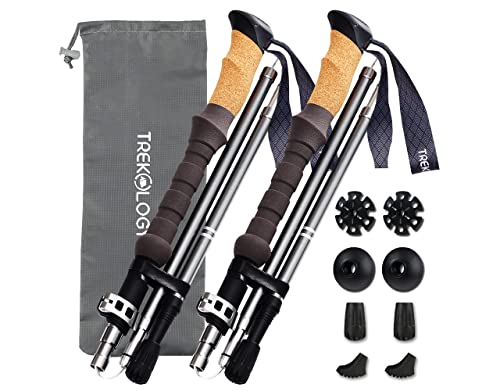
Three folding sections bring it down to 38 cm, close to the Black Diamond fold at a fifth of the price, with cork grips, 7075 aluminum shafts and metal flip locks. Trekology publishes 11.5 oz, or 330 g, per pole.
That comes to 23 oz the pair, heavier than the budget aluminum and heavier than anything else here, on a page that calls the poles ultra-lightweight. What you are buying is the folded size.
Who it is for
Hikers who need poles to fold into a daypack between trailhead and summit, and travelers packing a checked bag. The adjustment range is 110 to 130 cm, so tall hikers and shelter users are better served elsewhere.
What owners report
One owner describes flying twelve legs with the poles in cabin baggage, then having them taken off him on the last flight home. He says he picked folding poles so that he would never have to check a bag. Owners also describe the double grip working as intended, cork on top and foam below, so steep pitches need no length change, and the printed length marks make it easy to set both poles the same.
Flaws but not dealbreakers
23 oz the pair, the heaviest here, on a pole sold as ultra-lightweight.
20 cm of adjustment only, the narrowest range in this guide.
Trekology's own page sells the fold for carry-on travel while its Amazon listing says the poles must be checked.
Who this is for
This guide covers pairs for hiking and backpacking on trail, sold complete on Amazon, with carbide tips and baskets in the box. Prices run from about $30 to about $230, and every pair is quoted by the weight of two poles.
Ski touring and splitboarding ask for poles with long grips and large powder baskets, which is a different list. So is Nordic walking, where the strap does the work and the pole plants behind you. Anyone who needs a pole mainly for balance around town wants a walking stick.
Poles steady a load and take weight off your knees. A boot that pinches is another matter, and that is where our guide to lightweight hiking boots starts.
How to choose
The lock decides everything
Length is held one of three ways: an external lever you can see and tighten, an internal twist collar, or a folded cord with no adjustment. Every pair here uses a lever or a fold. Across the seven, the failures owners describe sit in locks and folding parts, and the lever is the only one of the three you can tighten on the trail with a screwdriver.
Makers of cork grips, Leki and Trekology among them, sell them on two claims: the cork takes the shape of your hand over time, and it stays drier under a sweaty palm. Foam is cheaper, lighter and warmer under a glove. Both beat hard plastic, which is what the cheapest poles in any shop use and the reason we left several of them out.
Length, fixed or adjustable
Set a pole so your forearm sits level with the ground when the tip is planted beside your foot, then shorten it on climbs and lengthen it on descents. Fixed-length folding poles skip all of that and save weight, which works if the poles are yours alone and your terrain is consistent. One pair shared between two people has to adjust.
Leki publishes the cleanest figures of anyone here, 240 g per pole with the Speed Lock Plus lever, and we still could not use it: no owner reviews of it are readable anywhere we tried. It also carries a separate ASIN for every length and color, from about $109 to about $120 for the same model.
At about $160, with 238 g per pole and an Aergon Air cork grip, this is the pair that would have undercut the Black Diamond Alpine Carbon Cork on price. It falls out for the same reason as the Khumbu Lite.
The $99.95 pole below our pick. It uses a TPR plastic grip instead of foam or cork, and the product page publishes two different weights for the same pole, 560 g in one line and 534 g in another.
A folding carbon pole at $219.95 that does adjust, unlike the Distance Carbon Z. An owner reports it collapsing repeatedly on a first hike in Vermont, and at 490 g the pair it saves nothing over the aluminum pick.
A backcountry pole at about $190 with a real following. The manufacturer's page for it returns an error, so every figure would have to come from resellers.
One of the best selling pairs on Amazon at about $40. There is no manufacturer site at all, so nothing about the pole can be attributed to anyone who makes it.
How we picked
Under 1 lb 8 oz the pairLever or fold locksCork or foam gripCarbide tips and baskets includedSold complete on AmazonOwner reports read
We started from 24 pairs sold in the US and took each maker's published figures first: weight in its original wording, adjustment range, collapsed length, shaft material, grip material, lock type and what ships in the box. Weight is the criterion that shaped the list and the one most often misread, because Black Diamond publishes a figure for two poles while Cascade, Foxelli, Leki and Trekology publish one. Every weight in the table above is for the pair, and every chip keeps the maker's own wording so you can check our arithmetic.
Owner reports came next, pole by pole, worst ratings first, on the makers' own product pages, where Black Diamond, Foxelli and Trekology publish them. Two pairs in this guide have no readable owner record at all, and their entries say so where the reports would have gone. The carry-on question comes from the TSA's own published rule as it stands in 2026.
Common questions
How long should my trekking poles be?+−
Plant the tip next to your foot on flat ground and hold the grip: your forearm should be roughly level, elbow bent square. That lands most hikers between 110 and 125 cm. Shorten by 5 to 10 cm for sustained climbs and lengthen by the same for descents, which is the argument for an adjustable pair.
Carbon or aluminum?+−
Carbon damps trail buzz and can be lighter, but it fails suddenly when loaded sideways, such as when a tip jams between rocks. Aluminum bends and keeps working. The price gap is real and the weight gap often is not: the carbon Black Diamond Alpine Carbon Cork is published 6 g heavier than the aluminum Black Diamond Trail.
Can I take trekking poles on a plane?+−
The TSA's published rule, as it stands in 2026, turns on the tip: blunt-tipped hiking poles are allowed in carry-on or checked bags, sharp-tipped ones are not. Every pair here ships with carbide tips fitted and rubber tips in the box, so fitting the rubber tips is the difference, and the officer at the checkpoint still has the final say. Folding poles fit a cabin bag; that is a separate question from whether they are allowed in one.
Are women's trekking poles different?+−
As of September 2026, Black Diamond redirects its women's Trail page to the standard one, same part number and the same 100 to 140 cm range, so for this pole the difference has gone. Buy on adjustment range and on how the grip sits in your hand, and if you are shorter than about 5 ft 4 in, check the minimum length before you read the label.
Do I need two poles or one?+−
Two, for hiking with a pack. The load shares evenly, the rhythm matches your stride, and a single pole leaves one side of your body doing all the work on a traverse. One pole makes sense for stream crossings and photography, which is why a few makers still sell single staffs.
The verdict
Buy the Black Diamond Trail
It has the widest adjustment range in this guide, levers you can service with a screwdriver, and carbide tips and snow baskets in the box, for about $90. Two things justify spending more: cork grips point to the Black Diamond Alpine Carbon Cork, and saving 7 oz for a fast trip points to the Black Diamond Distance Carbon Z, 120 cm.