Trail Gear Picks
Buying guide

Approach Shoes vs Hiking Boots for Climbing: Which to Wear, and the Best Pairs

I earn a commission if you buy through my Amazon links, at no extra cost to you. How this worksAmazon prices as of Nov 18, 4:16 PM ET, subject to change. Details

Approach shoes grip rock; hiking boots carry a heavy pack over long miles and take crampons on snow. When to wear each, with six pairs from about $125 to $400 and how owners say they fit.

By Alex HartDay trails mostly, a few nights out a year, mountains when the time allows.
Updated Nov 2026·22 compared

For climbing, approach shoes beat hiking boots: a flat, sticky sole and a smooth patch at the toe grip rock that a boot's deep lugs slide on. The La Sportiva TX4 Evo is the pair to get, at about $190. A hiking boot, with its thick sole and high collar, is still the better tool for long miles under a heavy pack.

If the climb sits at the end of a long, loaded walk, the TX4 Evo Mid puts the same sole on a waterproof mid boot. For days of trail under a heavy pack, buy a real hiking boot like the Quest 5, and for peaks with snow and crampons, the Zodiac Tech.

See the 6 picks

Top picks

La Sportiva TX4 Evo
Top pick
La Sportiva TX4 Evo

A low leather approach shoe with sticky Vibram Megagrip rubber and a smooth climbing zone at the toe. Comfortable on the trail to the crag, and it grips the slab above it.

Five Ten Guide Tennie
Climber's pick
Five Ten Guide Tennie

Stealth rubber wrapped up a beveled toe, the closest an approach shoe gets to a climbing shoe on small edges. Thick suede that takes a beating.

Scarpa Crux 2
All-day pick
Scarpa Crux 2

A soft, comfortable suede approach shoe that feels more like a hiking shoe. The one for long walks in and easy scrambling.

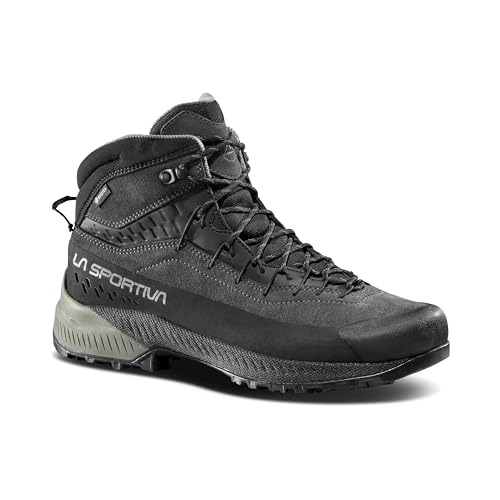
La Sportiva TX4 Evo Mid GTX
Approach boot pick
La Sportiva TX4 Evo Mid GTX

The TX4's climbing sole on a waterproof mid boot. Ankle support for a loaded pack, sticky rubber for the rock at the top.

Salomon Quest 5 GTX
Hiking boot pick
Salomon Quest 5 GTX

A tall backpacking boot with a plastic frame in the sole. For days of rocky trail under a heavy pack, where an approach shoe wears your feet out.

Scarpa Zodiac Tech GTX
Mountain pick
Scarpa Zodiac Tech GTX

A stiff leather mountain boot with a rubber rand and a heel welt for semi-automatic crampons. For scrambling peaks with snow on them.

At a glance

Product names go to Amazon. Rank numbers jump to the full write-up.

ShoeBest forPair weightCutWaterproofAbout
1La Sportiva TX4 EvoApproaches and scrambles1 lb 12 ozLowNo$190
2Five Ten Guide TennieEasy climbing in shoes1 lb 10.8 ozLowNo$125
3Scarpa Crux 2Long trail approaches1 lb 12.3 ozLowNo$160
4La Sportiva TX4 Evo Mid GTXScrambles with a packAbout 2 lb 3 ozMidGore-Tex$240
5Salomon Quest 5 GTXHeavy packs, long miles2 lb 10 ozHighGore-Tex$240
6Scarpa Zodiac Tech GTXPeaks and light crampons3 lb 1.4 ozHighGore-Tex$400

The approach shoes and boots, ranked

1Approaches and scrambles
La Sportiva TX4 Evo

La Sportiva TX4 Evo

A low leather approach shoe with sticky Vibram Megagrip rubber and a smooth climbing zone at the toe. Comfortable on the trail to the crag, and it grips the slab above it.

1 lb 12 oz a pairVibram MegagripClimbing zone at the toeResoleable
+Read the full write-up

Why I picked it

On a granite slab, a hiking boot's deep lugs stand on their tips and skate. The TX4 Evo puts a flat patch of soft Vibram Megagrip under your toes, so you can smear up a slab or stand on a small edge, then walk the rest of the trail on 4 mm lugs that still bite in dirt. The leather upper and a rubber rand all the way around take the scraping of cracks and talus.

A pair weighs 1 lb 12 oz, light for a shoe this sturdy, and the sole was redesigned so a cobbler can replace it when the rubber wears down. On easy fifth-class rock, up to about 5.8, it edges and smears well.

Who it is for

Climbers walking into the crag, scramblers heading up fourth-class ridges, and hikers whose favorite trails end on bare rock.

What owners report

Comfort comes up again and again, then how steady the foot feels on uneven ground. A buyer with narrow feet found the fit good for scrambles and easy climbs, which matters, since the TX4 has the widest toe box of La Sportiva's approach shoes. The complaints are about the leather: one buyer had a piece tear while lacing up on the second day of a trip, and a hiker found them comfortable and stable but not as tough as he expected.

Flaws but not dealbreakers

  • Leather breathes poorly; your feet run hot in summer.
  • Stiff for the first few miles before it softens.
  • The heel loop tangles with the laces, and only the top eyelets are reinforced.

Fit and sizing

Your usual size. Reviewers didn't need to size up, and the toe box leaves room.

2
Five Ten Guide Tennie
Easy climbing in shoes

Five Ten Guide Tennie

Stealth rubber wrapped up a beveled toe, the closest an approach shoe gets to a climbing shoe on small edges. Thick suede that takes a beating.

$123.75$165.0025% off
See it on Amazon
1 lb 10.8 oz a pairStealth Phantom rubberSuede upperRuns large
+Read the full write-up

Why I picked it

If the approach is short and the climbing is the point, the Guide Tennie is the one. Five Ten's Stealth rubber wraps up a beveled toe, so the front of the shoe holds a small edge almost like a climbing shoe. On slabs, boulders and low fifth-class terrain, it's the closest thing here to a climbing shoe. The thick suede is among the toughest on any approach shoe.

It costs about $125 on Amazon, well below its list price.

Who it is for

Climbers who scramble and climb easy pitches in their approach shoes and don't walk far to get there.

What owners report

Its weak spot is wet ground. The dotted tread is great on dry rock and poor on wet leaves, ice and the line between snow and rock, and four owners called the grip poor. Three found it isn't waterproof, one of them on a via ferrata. One owner had the sole of an older pair peel away seven miles from his car, with the rubber barely worn.

Flaws but not dealbreakers

  • Slippery on wet leaves and mixed snow and rock.
  • Stiff out of the box; break it in before a long walk.
  • Hot feet above about 80 degrees.

Fit and sizing

Runs large. Order a half size down from your usual, and expect the suede to stretch a little. Wide feet fit well.

3
Scarpa Crux 2
Long trail approaches

Scarpa Crux 2

A soft, comfortable suede approach shoe that feels more like a hiking shoe. The one for long walks in and easy scrambling.

1 lb 12.3 oz a pairVibram soleSuede upperComfortable out of the box
+Read the full write-up

Why I picked it

Some approaches are five miles of trail and a bit of easy rock at the end. For those you want a shoe that's comfortable first. The Crux 2 is a soft suede approach shoe with a Vibram sole, comfortable from the first walk, and it costs about $160. It weighs 1 lb 12.3 oz a pair, within a third of an ounce of the TX4 Evo.

The trade is a softer platform: it doesn't stand on small edges as well as the TX4 Evo.

Who it is for

Hikers and climbers whose approaches are long and the rock is easy, and anyone who wants one shoe for the trail and the crag.

What owners report

All four owners who've reviewed the new version like it. One wore it up a classic alpine rock route in Canada and on easy fifth-class guiding days and found it comfortable all day and good on scree. An owner with narrow feet says it fits like the first Crux. On the first Crux, one hiker had the leather at the toe crack at about 50 miles, and again on the replacement pair.

Flaws but not dealbreakers

  • Softer than the TX4 Evo, so less precise on small holds.
  • One owner of the first version had the toe leather crack, twice.

Fit and sizing

True to size. On the first Crux, 73% of buyers called it true to size and 93% true to width.

4
La Sportiva TX4 Evo Mid GTX
Scrambles with a pack

La Sportiva TX4 Evo Mid GTX

The TX4's climbing sole on a waterproof mid boot. Ankle support for a loaded pack, sticky rubber for the rock at the top.

About 2 lb 3 oz a pairVibram MegagripGore-TexClimbing zone at the toe
+Read the full write-up

Why I picked it

If you want one boot for the walk in and the rock, this is it. It's the TX4's climbing sole, sticky Megagrip with a smooth climbing zone at the toe, on a mid boot with a Gore-Tex lining and a suede upper with a rubber toe cap. Your ankle gets support under a loaded pack on the walk in, and the rock at the top gets the same grip as the low shoe.

At about 2 lb 3 oz a pair, it's lighter than a backpacking boot like the Quest 5, and the sole can be replaced. It costs about $240.

Who it is for

Climbers carrying a rope and a rack to a long approach, alpine scramblers, and hikers who want one boot that climbs.

What owners report

One owner has worn his an hour a day for three years on stony forest tracks with his dog, in all weather, and they've held up; he oils the suede toe to keep it from cracking. Fit is the sore point. A longtime TX4 wearer found this version narrower in the width and the toe box, and another buyer returned his because the left boot rubbed his inner ankle.

Flaws but not dealbreakers

  • Narrower than older TX4 models; try it on if you have wide feet.
  • Gore-Tex and leather run warm in summer.
5
Salomon Quest 5 GTX
Heavy packs, long miles

Salomon Quest 5 GTX

A tall backpacking boot with a plastic frame in the sole. For days of rocky trail under a heavy pack, where an approach shoe wears your feet out.

2 lb 10 oz a pair4D chassisGore-TexOne width
+Read the full write-up

Why I picked it

Three days on a rocky trail with 35 pounds on your back is a job for a hiking boot. An approach shoe's stiff, thin platform wears your feet out over miles like that, and it gives your ankles nothing. The Quest 5 has a high collar, a Gore-Tex lining and a plastic frame in the sole that keeps the foot steady on loose rock under a heavy pack.

It's a hiking boot, not a climbing one. Its lugs are made for dirt and mud, and on a smooth slab it won't stick like the shoes above.

Who it is for

Backpackers on long, rough trails, and anyone whose climb is a walk-up summit at the end of several days in.

What owners report

No owner has complained yet. One carried 35 pounds for three days of camping in New York's High Peaks with wide feet and came home with no blisters, and several say it was comfortable without breaking it in.

Flaws but not dealbreakers

  • Heavy, at 2 lb 10 oz a pair.
  • One width only.
6
Scarpa Zodiac Tech GTX
Peaks and light crampons

Scarpa Zodiac Tech GTX

A stiff leather mountain boot with a rubber rand and a heel welt for semi-automatic crampons. For scrambling peaks with snow on them.

3 lb 1.4 oz a pairTakes semi-auto cramponsRubber randRoomy toe box
+Read the full write-up

Why I picked it

Once the scramble to the summit has snow on it, you need a boot that takes crampons, and the Zodiac Tech does: a stiff leather boot with a heel welt for semi-automatic crampons, a thick rubber rand around the toe and a Vibram sole. It feels more like a light mountaineering boot than a padded hiker, and it handles eight to ten hours of steep shale and boulders.

At 3 lb 1.4 oz a pair and about $400, it's overkill for a normal trail.

Who it is for

Hikers moving up to snowy peaks and mixed alpine routes, where crampons come out.

What owners report

Owners mostly praise how tough it is and how well it grips. One buyer got blisters and still recommends it. A mountaineer with twenty years behind him found the medium fit a little wider than other Scarpa boots.

Flaws but not dealbreakers

  • Firm, thin cushioning for a boot this size.
  • Hot below the snowline in summer.

Fit and sizing

Roomy in the toe. Wear thick wool socks so your foot doesn't slide on descents.

Who this is for

This guide is for climbers and scramblers deciding what to wear on the walk in. The short answer: if your day ends on rock, get approach shoes; if it's long miles, a heavy pack or snow, keep the boots. For plain trail hiking without the rock, our hiking boots guide and lightweight hiking shoes are a better place to start. On icy winter approaches, crampons vs microspikes covers the traction to add.

How to choose

Approach shoes vs hiking boots for climbing

Look at where the day ends. If it ends at the base of a route or on a fourth-class ridge, wear approach shoes: the sticky rubber and the flat toe will get you up rock that a boot's deep lugs slide on. If the rock is only a short scramble at the end of a long walk with a heavy pack, the hiking boot's cushioning and ankle support matter more.

Approach shoes vs hiking boots for climbing mountains

On a summer peak with a dry ridge, an approach shoe or the TX4 Evo Mid is lighter and climbs better. As soon as the route has snow you'd kick steps in, or a glacier, you need a stiff boot that takes crampons, like the Zodiac Tech. Approach shoes have no welt for crampons, and a soft sole won't hold a step.

Approach shoes vs hiking shoes

A low hiking shoe is the closest to an approach shoe, but it's built the other way: a rockered sole and harder rubber for dirt and mud. An approach shoe has a flat sole and soft, sticky rubber for rock. Hiking shoes are more comfortable over long miles; approach shoes are more precise on rock.

Approach shoes vs trail runners

Trail runners are lighter and softer, and for a short, easy walk to a crag they're plenty. But they fold on small edges and their rubber isn't made to stick on rock. If the approach has real scrambling, wear approach shoes. If you just want something light and fast on trail, our trail running shoes guide is the place to look.

The competition

La Sportiva TX2 Evo

Lighter than the TX4 Evo at 1 lb 4.4 oz a pair, about $170. For a long approach, the TX4 Evo is the sturdier shoe.

La Sportiva TX Guide

A precise, technical scrambling shoe at about $200, but narrow, and its mesh doesn't last as long as the TX4's leather.

Scarpa Rapid XT

A hiking-minded approach shoe at about $180 and 1 lb 12.2 oz a pair. The Crux 2 covers the same ground for less.

Black Diamond Technician Pro

A good scrambling shoe, but at about $230 it costs about $40 more than the TX4 Evo.

La Sportiva Boulder X

About $160, but 2 lb 1.9 oz a pair, heavy for a low shoe.

Zamberlan Salathe GTX RR

A burly, supportive mountain approach boot at about $300, but heavy, clunky and men's only.

How I picked

Sticky approach rubber or a mountain Vibram solePair weight published or measuredOne clear job: crag, scramble, pack or cramponsSold in common men's sizes

Three low approach shoes, one approach boot and two mountain boots, from the crag to a snowy summit. I read the reviews from Switchback Travel, OutdoorGearLab and GearJunkie, Mammut's buying guide, and owner reviews on Zappos and Bergfreunde for fit and wear.

Common questions

Are approach shoes better than hiking boots for climbing?+

For rock, yes. Their sticky rubber and smooth toe grip slabs and small edges that a hiking boot's lugs slide on. Hiking boots are better for long miles with a heavy pack, for snow, and for mountains where you'll need crampons.

What's the difference between approach shoes and hiking shoes?+

Approach shoes have a flat sole, soft sticky rubber and a smooth climbing zone at the toe, made for rock. Hiking shoes have a rockered sole and harder rubber with deeper lugs, made for dirt and mud over long distances.

Can you hike in approach shoes?+

Yes, on most trails. They're stiffer and less cushioned than hiking shoes, so on long days with a heavy pack your feet will feel it. The Crux 2 is the most comfortable of these for long walks.

Approach shoes vs trail runners: which should I wear?+

Trail runners for a short, easy walk to the crag. Approach shoes if the approach has scrambling or you want to climb easy pitches without changing shoes.

Can you climb in approach shoes?+

Easy rock, yes: fourth class and low fifth class, up to about 5.8 for a stiff shoe like the TX4 Evo. For harder routes, carry climbing shoes and change at the base.

The verdict

Get the TX4 Evo for rock

For about $190, the TX4 Evo gives you a shoe that walks the trail and climbs the rock at the end of it, with sticky rubber and a sole you can replace.

If the walk in is long and loaded, the TX4 Evo Mid adds a waterproof mid boot. For days of trail under a heavy pack, keep a hiking boot like the Quest 5, and for snowy peaks, the Zodiac Tech.

Related guides